Book Review: Syntax by Zac Porter
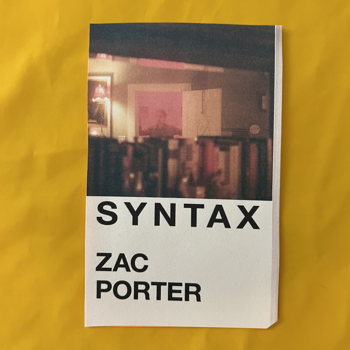 Artwork by Syntax
Zac Porter’s debut novel, Syntax, is a new-age Bildungsroman that navigates the postmodern, the ever-budding rhizome of existence that the narrator, Paul, contends with. The story follows Paul in the days leading up to the premier of an avant-garde film, Film(01), histoire(s) de l’internet. Paul’s circulating in the meantime resembles the mingling in a lobby before the matinee – a lobby of 20-something bohemians – the film itself serving as a long-awaited statement by Angelicism, one member of the circle: a statement being the most important thing a young artist can and must do – and must be thinking about; a stand-alone idea from a cigarette philosopher, one being how the Avengers film series works as a modern-day substitute for Christianity.Whether or not Captain America can turn water into wine isn’t the point, though. “Writing…” Porter says, is “An instinct that leads you into a confrontation with what is anxious; the borders of being; the limits.” This, along with his contention that writing is, one, meant to understand desire and, two, done to bring someone to tears is enough to mark this work, in one way, as a testament for creativity, a raison d'être.
The peers Paul finds himself surrounded by in this urban odyssey serve as a kind of amorphous artistic movement, each spinning ideas off one another: A long track of intellect is measured against the now of a young man eagerly maneuvering through an unfamiliar metropolis – and it seems every person, event, and thing he encounters is juxtaposed to a theory, a google-able abstraction. Art, in this book, is the antithesis of loneliness; impossible to be done right without a significant nod to both community and former visionaries alike.
Paul sees the history of critical theory as a way of understanding the world. “…every plateau [is] a charging dock.” He builds a worldview skeptical of the internet, of the unceasing flow of information filtered to us through screens. Credence is given not to AI but to Carl Jung. Bits of information are clustered into digestible snippets of either prose dialogue or the narrator’s own take on, say, Houellebecq’s originality, or the programmatic relations between pixel grids and photographs. The application of brevity to the postmodernistic field of theory is impressive; not encyclopedic but exacting semantically anything from the indeterminacy of a mandala to social engagement of the alt-lit. In this way the novel feels complete as an examination of the narrator, Paul, not just for his hot takes but in the way we follow him through New York City as he makes sense of himself by observing the other young, tormented artists he seems to feel at home with.
New York is the ideal setting for interlaying the teleology of love – and the philosophy of temptation – with the ideas of Paul’s coevals whose words don’t matter so much for delineating the benefits of writing for a post-human future as they do in revealing their character’s ambitions, fears, joys, and sorrows. What elevates these characters is not just the unique voice Porter finds for each one but his respect for, yes, syntax itself: a challenging choice for a novel’s title, if not bold, but Porter pulls it off with interesting moves that pay homage to “the greats” while maintaining an edge of modernity and a lean into the experimental. “There are patterns sprouting everywhere I look… but the patterns themselves are meaningless,” Porter writes. “It’s the syntax between them that’s the locus of meaning.”
This is the journey of a young and curious intellectual today – the passionate reimagining of ideas from great thinkers; finding confidence within an ocean of theoretical frameworks; compartmentalizing the zeal for holding in one’s mind a millennia of brilliance without giving oneself away as a naive youth. Syntax is a smart rendering of Paul’s enthusiasm for the arts that forces bookshop veterans not to grin in condescension but feel the reignition of a youthful fire that seems to fade and disappear altogether by middle age.